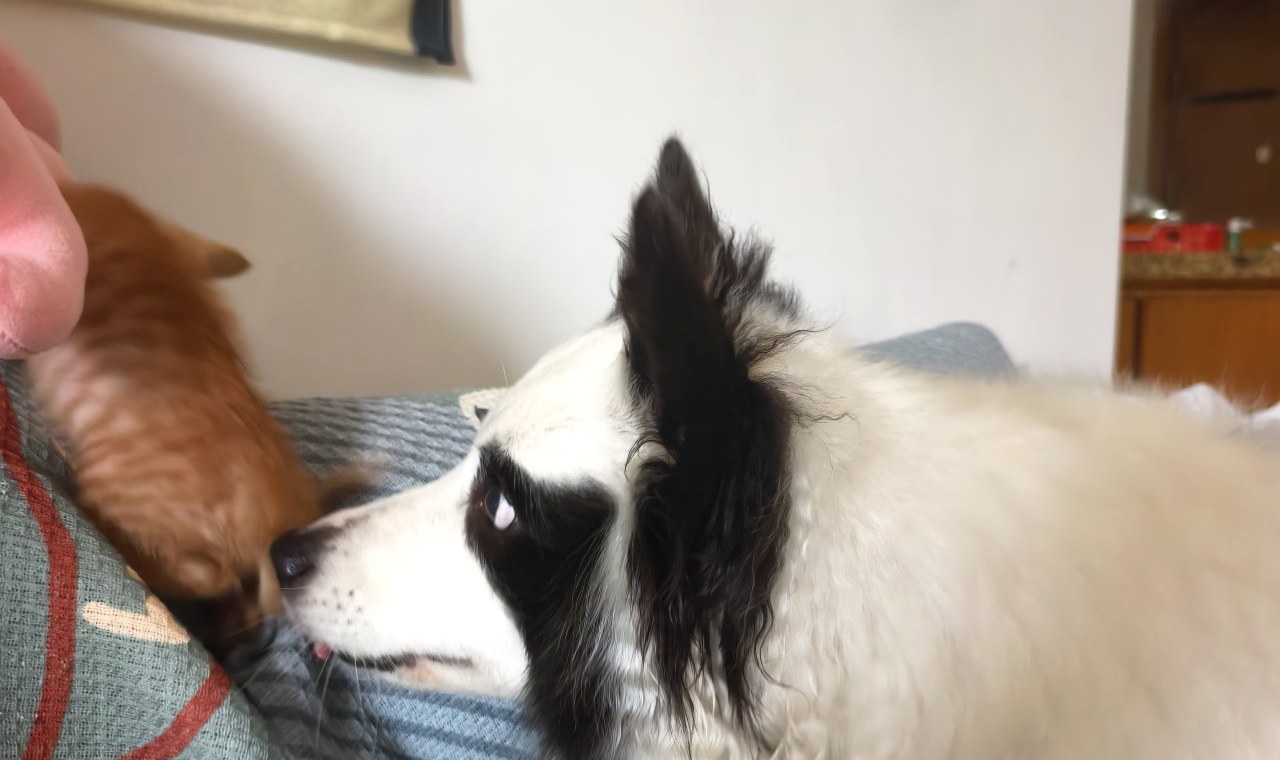





On the second morning, Biscuit followed the kitten from the bedroom to the kitchen, lowered his head until his nose was almost touching the orange fur, and got hissed at for his trouble.
He wagged. He tried again.
Forty-eight hours earlier, we had a plan to give the kitten away.
Why we expected this to go badly
Both of our worries were about Biscuit.
The first is that he is possessive about affection. He is a medium-sized mixed-breed dog who has spent years perfecting one specific skill: noticing the exact moment a human hand moves toward another animal. Pet a neighbour’s dog in front of him and he will quietly insert his entire body between you and it. There is no aggression in it — just a calm, immovable insistence that the hand belongs to him.
The second worry is stranger. He is afraid of cats. Nothing bad has ever happened to him. He simply does not know what to do with an animal that stares at him without blinking and refuses to be charmed.
So when we found a tiny orange kitten on the street — skinny, loud, and completely unbothered by the concept of dogs — we did the arithmetic. A jealous dog plus a confident kitten usually ends with one of them living behind a closed door. We set a deadline: if it was not working by the national holiday, the kitten would go to my parents’ place in the countryside.
It never came to that. What follows is what we did in the first two days, and what we would do again — including the parts that turned out to matter far more than we expected going in.
What we actually did
Two things before the list. We are not trainers, and this is not medical advice. We improvised most of this by watching which moments made either animal tense up — a tail that stopped wagging, a pause in breathing, a head that went still. What is below is what we kept doing because it worked, not something we read first and then tried.
1. We kept them apart and let smell do the introductions
The kitten spent his first day behind a closed door, in a room with his own food, water, litter tray and somewhere to hide. Biscuit could hear him and smell him through the door. For twenty-four hours, that was the entire introduction.
In the evening we swapped bedding — a cloth that smelled of the kitten left where Biscuit sleeps, a cloth that smelled of Biscuit left near the kitten’s food. Neither animal reacted much. That was the point. We wanted the new smell to become boring before the new animal became visible.
A cat makes up its mind about a new animal long before it ever lays eyes on it, and a closed door does not hide a smell — it only slows it down. That is why we worked through this in stages: scent first, then a gap in the door, then a baby gate, and only then the same room. A dog that spends half his life sniffing lampposts reads the world the same way. Separating them is not about keeping them apart forever — it is about making the first real meeting uneventful.
2. We refused to let the dog feel demoted
If we could keep only one thing from this list, it would be this one.
The instinct when you bring home a rescue kitten is to fuss over it constantly. It is small, it is scared, and it asks for you. That is exactly the instinct we fought. For the first two days, Biscuit got petted first, fed first, walked first. When we came home, we greeted the dog before we even looked into the kitten’s room. The kitten waited. The kitten was fine.
Here is why it matters. A resident pet that suddenly loses attention does not blame the situation — it blames the newcomer. Once that link is made, the new animal stops being a curiosity and becomes the reason everything got worse. The response to that is rarely friendship.
Two days in, Biscuit was still getting the first pat of the day. He was also the one following the kitten around.
3. Nothing was shared
Two food bowls. Two water bowls. A litter tray in a room the dog never enters. A dog bed and a cat bed in different rooms. Not one communal toy.
Shared resources are contested resources. If there is one bowl, somebody has to think about the bowl. If there is one good sleeping spot, somebody has to own it. Give each animal its own version of everything that matters, in a separate place, and there is nothing left to argue about.
The same logic stops two children fighting over one toy: whatever there is only one of becomes something to own. Spread everything out, put each item in its own corner of the house, and there is nothing left to guard, nothing to squeeze past, and no reason for either animal to stake a claim. The kitten’s tray went into a room Biscuit never enters. Biscuit’s bowl stayed exactly where it had always been.
4. We watched — and then we made ourselves stop watching
Once both animals were in the same room, our main job was keeping our hands off.
When Biscuit shoved his nose into the kitten’s ribs and the kitten hissed, that was not a fight. It was a boundary, clearly stated. Our instinct was to grab the dog and shout — and the first time we did, both animals froze and looked at us instead of at each other. That is the whole problem with it: it teaches them the same lesson, that when the other one comes near, the humans get upset.
So we sat on our hands. If nobody was frozen, nobody was cornered and nobody was running, we let them work it out. Presence, not participation.
Shouting takes tension out of a moment; it puts tension into the room. The thing that actually changed Biscuit’s behaviour was never the correction we added — it was the alternative we offered him: something better to do than stand over a kitten.
Where we did step in
“Leave them alone” is not a blank cheque, and there were three things we interrupted every single time.
- Chasing that would not stop. A dog trotting after a kitten is curiosity. A dog herding it into a corner and doing it again is not.
- Anybody going rigid. A cat that stops moving and stops blinking is not relaxed. It is out of options.
- Any paw coming down. One playful paw from a medium dog weighs more than the entire kitten.
Two habits kept those interruptions from turning into a drama: we never shouted, and we never separated them as a punishment. We redirected instead — a toy for the dog, a shelf for the kitten — and gave them a few minutes apart before trying again.
We also gave the kitten somewhere to go that the dog cannot follow. A cat that can leave a room has no reason to fight for it, and vertical space is the cheapest exit there is: a cat tree, a windowsill, the back of a sofa a dog will not jump onto. We put ours up on day two. Within an hour it had stopped being furniture and become the kitten’s default position.
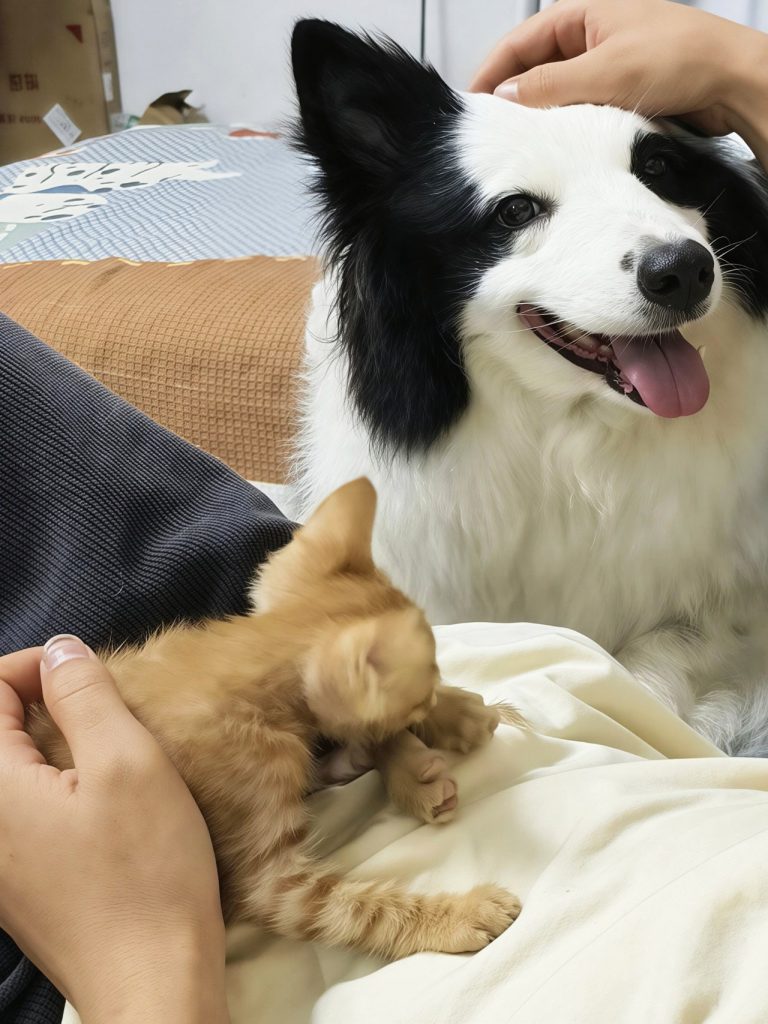
What the first 48 hours actually looked like
Day 1, morning. The kitten arrived in a carrier and went straight into the spare room. Biscuit sniffed the door for a long time, then lay down in front of it, which we chose to read as a good sign.
Day 1, evening. Bedding swap. Both animals ignored it, which was exactly what we were hoping for.
Day 1, night. First look, through a gap in the door. Biscuit’s tail went up. The kitten stared. Nobody did anything dramatic, so we called it a success and closed the door.
Day 2, morning. Door open, with one of us sitting on the floor. Biscuit came in, saw the kitten, and left. Then did it again.
Day 2, midday. He came back, sat down about a metre away, and stared. The kitten ignored him completely.
Day 2, afternoon. The nose went in. The kitten hissed. The nose came back. From that point on, Biscuit simply did not stop following the kitten — sniffing his back, nudging him with his snout, getting hissed at, and returning for more.
Day 3 onwards. The following continued. So did the hissing, which thinned out over the next few days as the kitten worked out that the giant furry thing was not going to eat him.
The part we did not skip
A kitten found on the street arrives with more than fleas and an opinion.
Before any introductions, he needs a vet: an age estimate, deworming, a check for the diseases that pass easily between cats, and the start of a vaccination plan. Until a vet has seen him and told you what to watch for, your separation phase is doing two jobs at once — it is the behaviour plan and it is the quarantine.
That matters more than the introductions do. A sick kitten will not cope with a new dog. A kitten with worms will share them. And the calm, unhurried version of everything above is far easier to run when you already know that the kitten’s health is being handled.
We also did the boring parts: washing hands between handling the two animals during the separation phase, and keeping the kitten’s bedding and bowls well away from the dog’s until a vet gave us the all-clear. None of it is dramatic, which is exactly why people skip it.
Common questions
How long does an introduction like this normally take?
Longer than ours did. A week to a few months is the usual range, and it depends far more on the animals than on technique. What we had going for us was a kitten young enough to be curious rather than territorial, and a dog with no history of aggression. If either of those is different in your house, slow down.
Should I worry that the dog is obsessed with the kitten?
Following, sniffing and nudging is investigation, not aggression. It becomes a problem when it stops being reversible — when the kitten cannot cross a room without being herded, cannot eat in peace, or starts hiding for long stretches. The test is whether the kitten still behaves normally when the dog is around.
Is it OK that the dog licks the kitten?
Usually, yes — a lot of it is grooming behaviour, and it tends to mean the dog has filed the kitten under “household” rather than “intruder”. Watch the kitten’s reaction. Licking that ends with the kitten walking away is fine. Licking that pins the kitten down is not.
What if the dog keeps chasing and will not stop?
Then end the free access and go back a step. Separate them again, do more supervised contact with the dog on a leash, and give the dog something genuinely more rewarding to do than herding. If the chasing has real intensity to it, or the kitten is actually being caught, bring in a certified behaviour consultant or a veterinary behaviourist rather than working it out at home.
Does the jealousy ever go away?
Ask us in a year. It has not gone away here — Biscuit still body-checks us whenever we pet anything else — but it has stopped being aimed at the kitten specifically, and that is the part that mattered.
Where they are now
He is not a different dog. He still shoves his way in front of anyone who pets another animal, and he still follows us from room to room.
But he also follows the kitten. And the kitten — who spent day one hissing at him — now sleeps against his side and treats him as furniture.
Not every dog and cat fall for each other in two days. Some never do, and those households run perfectly well on a baby gate and two separate routines. But if you are looking at a jealous dog and a new kitten and quietly assuming the worst, give it a proper two weeks before you decide anything permanent.
The kitten we were going to send away is asleep on the dog’s tail as I write this.
One thing here is not optional: a kitten found on the street should see a vet before any of the rest of this matters. And if the dog in your house has a history of hurting other animals, get a qualified behaviour consultant involved rather than working from a blog post — including this one.